
Hi everyone,
As we reach the halfway point of 2026, I’d like to take a moment to reflect on six months in which we set out to prove something very specific.
In January, alongside our 2025 results, we made a public commitment: 2026 would be the year Decklar expands the industry from exception detection into autonomous resolution loops—AI that doesn’t just tell you what’s going wrong, but resolves it automatically. In the first half of 2026, that conviction became production reality.
This letter is the halfway-point receipt on that commitment.
RADAR, our autonomous control tower, now executes across dispatch, in-transit, and delivery; the measured results Global 2000 customers are seeing across five verticals—from 90%+ automation of quality inspection, bandwidth to $5.2M projected impact for an automotive major to70-90% higher GSOC productivity; it’s compounding supply chain knowledge graph, the 3 key industry recognitions that followed; what pharma leaders told us at LogiPharma; and how we run Decklar itself using the AI we sell.
Here’s the update from H1 2026…
The Foundation for Autonomous Supply Chain Execution—Powering Global 2000s
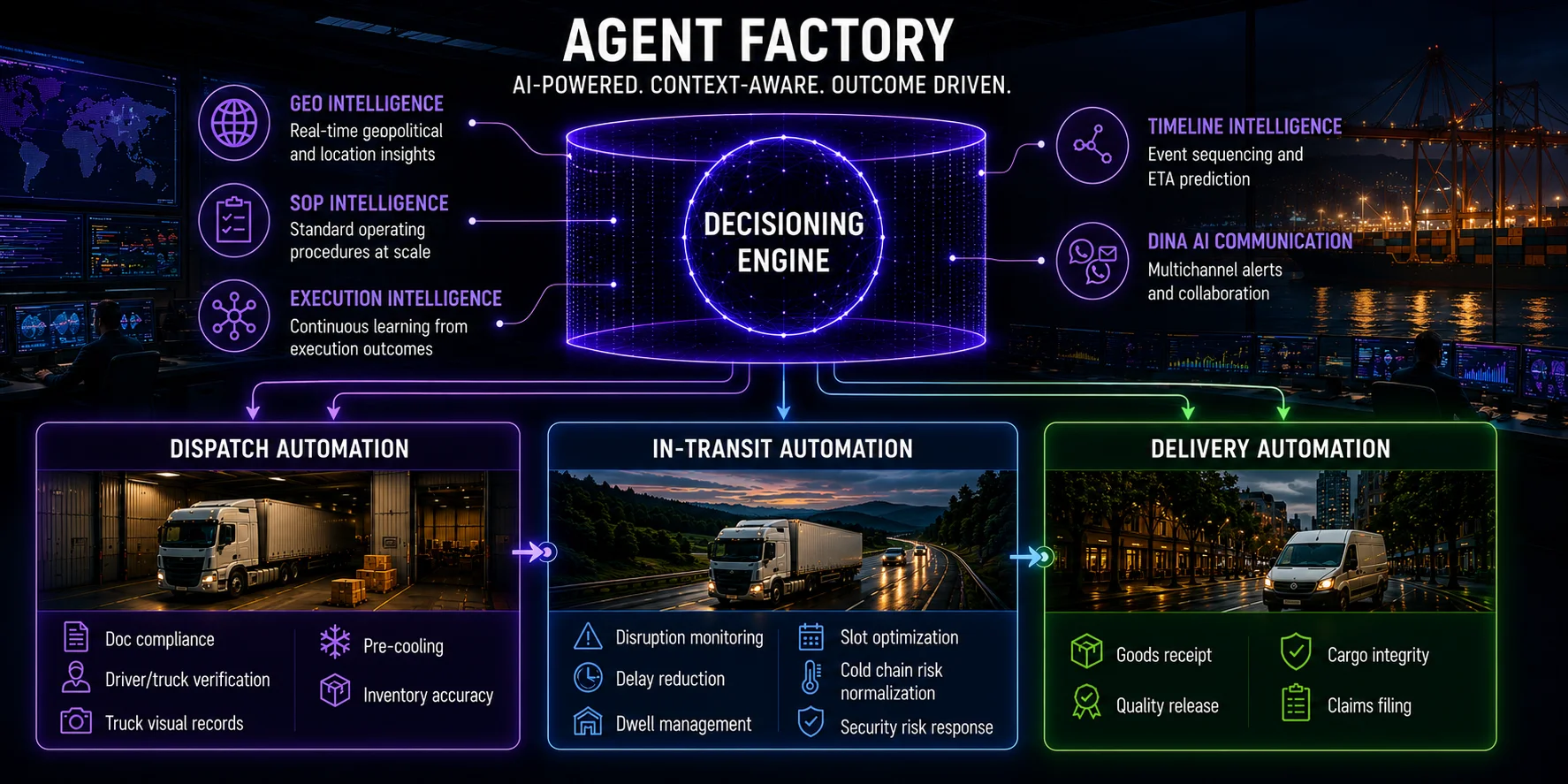
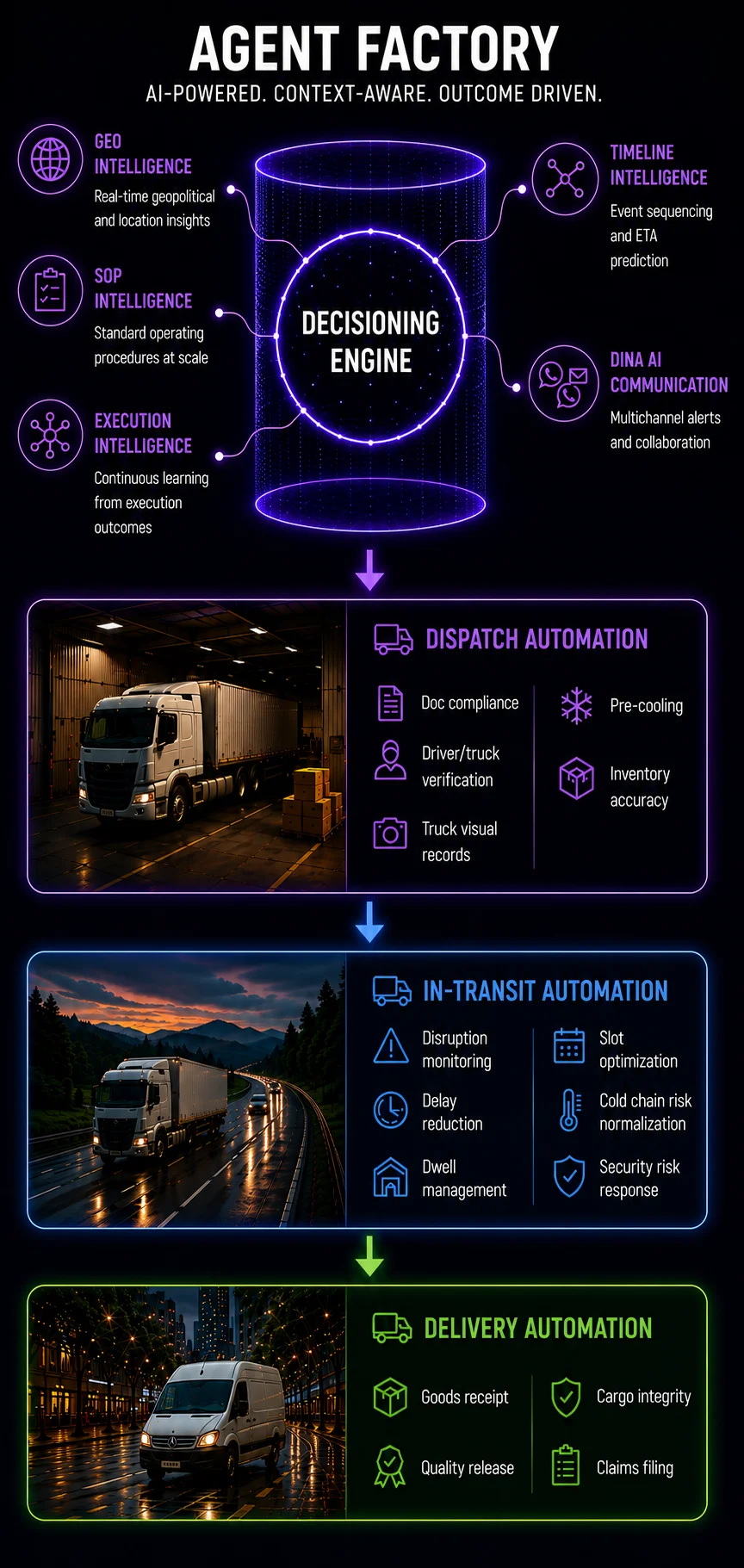
One of our biggest investments during H1 was expanding the autonomous execution capability inside RADAR, the industry’s first fully autonomous logistics control tower (LCT). At its core sits an Agent Factory—a growing library of specialist AI agents, each pre-trained for a specific task on a specific leg of the logistics journey, and powered by six complementary intelligences:
- Geo Intelligence – risk profiles of every road, air, ocean, and rail connection
- Timeline Intelligence – learned transit, dwell, and milestone patterns on every lane
- SOP Intelligence – each customer’s own playbooks, encoded and enforced
- Decisioning Engine – selects the next best action, autonomously
- DINA – the AI communication layer across Voice, Email, SMS, and WhatsApp
- Execution Intelligence – a self-enriching graph of how exceptions actually get resolved: the right contact, channel, timing, and escalation path
At dispatch, agents validate trade-compliance documentation, manage timely signatures and filings to ensure on-time dispatch, verify driver credentials, truck integrity, pre-cooling, and inventory accuracy during loading.
In transit, they assess disruption risk and execute SOP-driven responses—managing delays, reducing dwell at ports, airports, and cross-docks, dynamically managing time slots, and mitigating cold-chain and security risks.
At delivery, they compress order-to-cash and labor time by automating goods receipt, quality release, cargo-integrity verification, and claims filing.
And they don’t work alone: multiple agents operate within a single business workflow—an important step toward truly autonomous supply chains, where AI doesn’t simply observe disruptions and risks, but decides and executes in real time.
A Compounding Supply Chain Knowledge Graph of Physical + Executional Truth
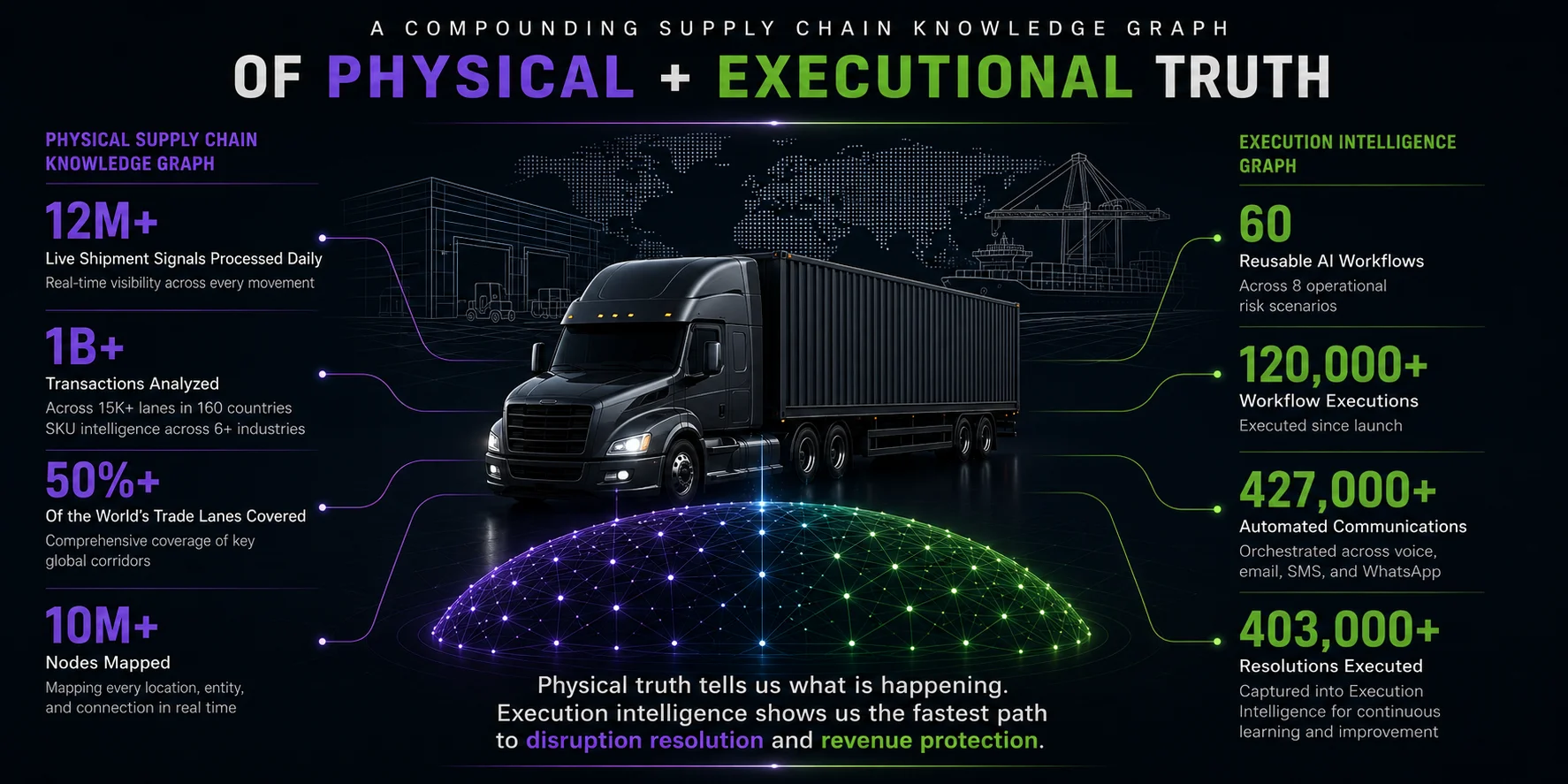
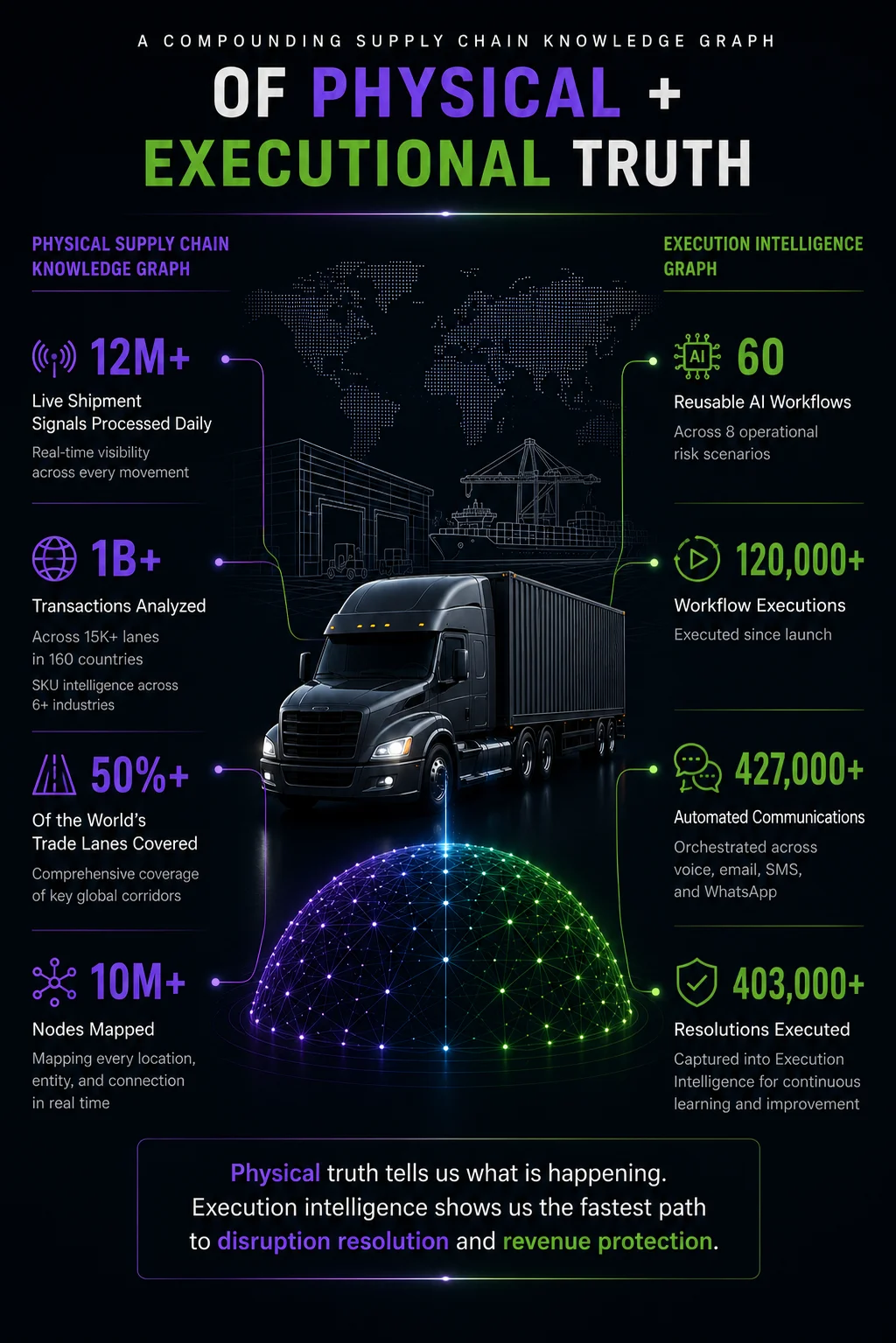
Our autonomous AI control tower runs on two compounding layers of intelligence. The first is our physical supply chain knowledge graph: 12M+ live shipment signals processed daily, 1B+ transactions analyzed across 15K+ lanes in 160 countries, and 10M+ nodes mapped—covering over 50% of the world’s trade lanes, with SKU-level product intelligence across six-plus industries. The second is newer, and compounds faster: Execution Intelligence.
Since launch, 60 reusable AI workflows across 8 operational risk scenarios have executed more than 120,000 times—orchestrating 427,000+ automated communications and executing 403,000+ resolutions. Every one of these interventions is captured into Execution Intelligence: a self-enriching knowledge graph of the fastest path to disruption resolution and/or downstream revenue protection—who to contact, on which channel, at what moment, and what to communicate. The visibility graph tells Decklar’s agents what is happening; the execution graph recommends the shortest path to resolution.
Measured across 11 Global 2000 deployments, customers are seeing a 60–70% reduction in alert response time, with critical escalations managed in under two minutes.
Proven With Our G2000 Customers, Recognized by the Industry: Five Verticals, Three Awards in H1 2026
Capabilities matter only when they survive contact with real operations. Here are three examples from H1:
90% less quality-inspection time for a world-leading ice-cream maker. Across its Asia cold chain, the brand implemented Decklar’s autonomous quality release to eliminate more than 90% of quality-inspection bandwidth at dispatch and delivery, fueling millions in annual savings across their network.
$5.2M in project annual impact—$1.6M in savings & $3.6M in unlocked revenue—for a leading US commercial truck manufacturer. Measured at a single plant, stranded totes fell 53%, asset availability rose from 82% to 92%, annual asset turns grew 11.4%, and ten hours a week of manual tracing dropped to zero—projecting to $5.2M in annual impact at full scale across 28 plants, with $3.6M of it being revenue unlocked by redeploying freed assets to unserved demand. Read the full story here.
GSOC productivity up 70–90% across pharma, electronics, and regulated CPG. Key customers in these verticals now run secured dispatch, in-transit risk intervention, and integrity release on Decklar—turning manual monitoring into autonomous exception management, with Global Security Operations Centers projected to operate at 70–80% of traditional staffing. Read the full story here.
Different industries, same pattern: the loop closes, the manual work disappears, and the savings land where a CFO’s office can verify them.
On the back of this proven customer impact, Decklar was recognized in H1 2026 as:
- 2026 Inbound Logistics Top 100 Logistics & Supply Chain Technology Provider
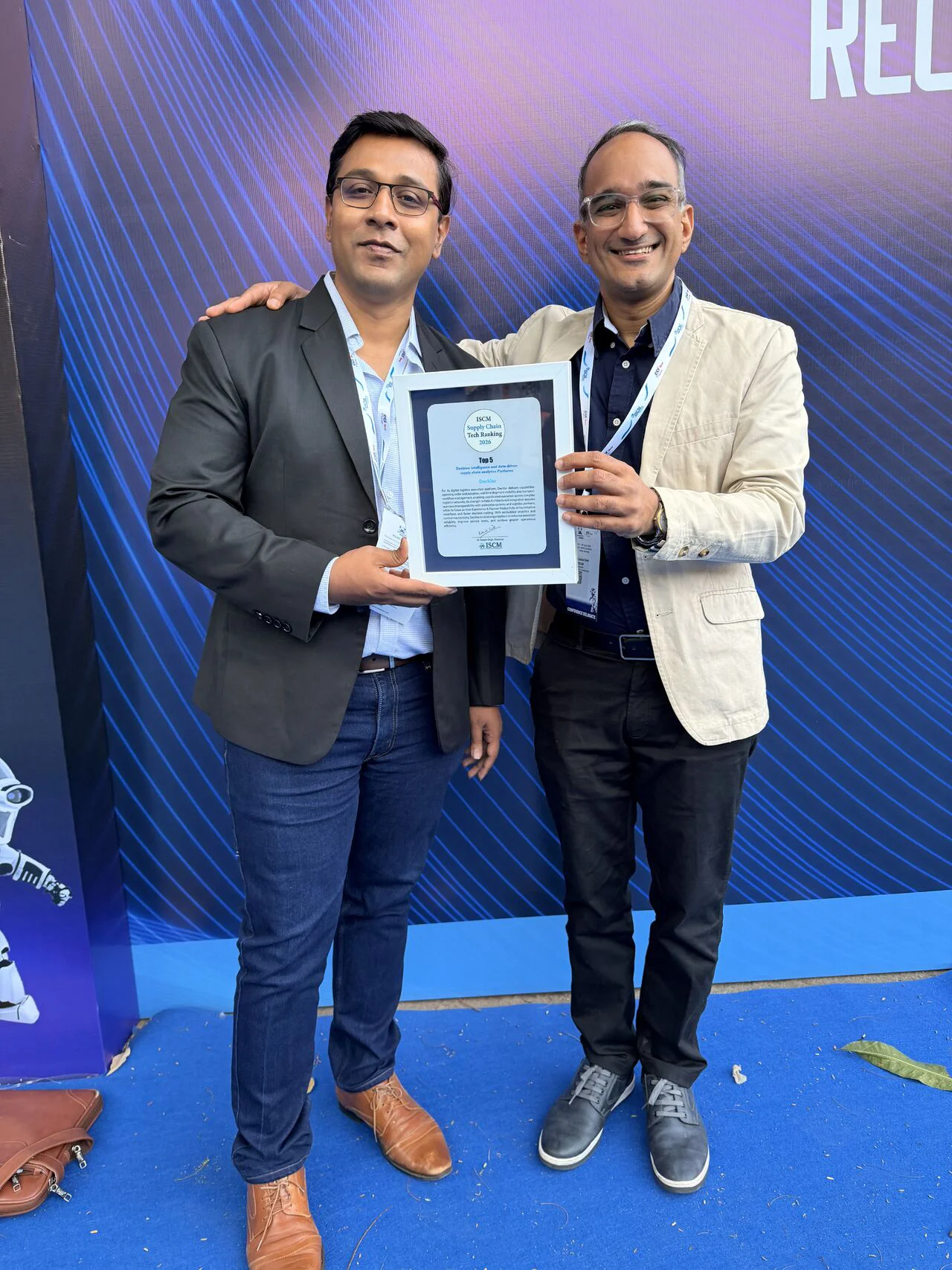
- ISCM Supply Chain Tech Ranking 2026 – Top 5 Decision Intelligence and Data-Driven Supply Chain Analytics Platform
- AI Breakthrough Awards – AI-based Supply Chain Solution of the Year
45+ Conversations That Matter: Masterclass at LogiPharma 2026
This April, our team travelled to Vienna for LogiPharma 2026—45+ conversations with pharmaceutical manufacturers, logistics leaders, and quality and security professionals from around the world.
What struck me most wasn’t the technology being discussed.
It was how much the conversation has evolved.
Only a few years ago, AI conversations focused almost entirely on visibility, dashboards, and analytics.
Today, organizations are asking a different set of questions.
How can AI reduce operational complexity?
How can it help teams make decisions faster?
How do we move from reactive operations toward autonomous execution while maintaining compliance and quality?
These themes formed the basis of our masterclass, Mastering Pharma Supply Chain Leadership in the Age of AI Agents & Digital Workers, where we explored how Decision AI, AI agents, and human expertise will increasingly work together to shape the next generation of pharmaceutical supply chains.
We’re incredibly grateful to everyone who joined us and shared their perspectives. Those conversations continue to shape the products we build today.

Practicing What We Build at Decklar
One of my favorite stories from H1 didn’t involve a customer, but about dogfooding our own AI.
It started with one of our engineering teams asking a simple question:
Could AI make daily standups better?
Like many organizations, standup meetings often took longer than planned. They interrupted focused work, consumed valuable time, and weren’t always the most efficient way to share updates.
So, the team decided to experiment.
Using DINA, our own platform’s Voice AI, they created an internal workflow where an AI agent calls each team member, gathers progress updates, identifies blockers, follows up on previous commitments, and automatically produces a concise team summary.
What began as an engineering experiment quickly spread across marketing, sales, and other business functions.
The outcome was simple: one hour less time spent in meetings every day, more time spent doing meaningful work.
It’s a great reminder that AI doesn’t just solve billion-dollar problems—its impact compounds in the everyday experiences teams encounter hundreds of times a year.
Growing the Team Behind Decision AI – We’re Hiring
As demand for Decision AI grows, we continue investing in the talented people who make it possible across our offices worldwide—while staying disciplined on the fundamentals we reported in January.
Every new team member brings fresh ideas, new perspectives, and a shared passion for solving some of the world’s most complex supply chain challenges.
If you’re looking to help shape the future of autonomous supply chains, I’d encourage you to explore our latest opportunities.
Looking Ahead
As we look ahead to H2 2026, the focus is singular: extending autonomous resolution from individual workflows to entire networks—more solutions per customer, more loops closed without human touch, and more of the world’s trade lanes running on Decision AI.
If you’d like to see the autonomous resolution loop running against your own lanes—not a demo environment—my team will set up a working session which you can request here.
Thank you to our customers, employees, investors, partners, shareholders, and the entire Decklar community for your continued trust and support.
We’re excited for what’s ahead.
Warm Regards,
Sanjay Sharma,
Chairman & CEO
Decklar

Sanjay Sharma, Chairman & CEO, Decklar
Sanjay Sharma is a strategic thought leader with an impressive 17+ years of entrepreneurial experience building technology startups from the ground up. As CEO of Decklar, he is responsible for leading the company’s vision, driving its worldwide business growth, and increasing Decklar's value. Sanjay has successfully co-founded and led two successful Silicon Valley technology startups - KeyTone Technologies, which was acquired by Global Asset Tracking Ltd and Plexus Technologies, which became an ICICI Ventures portfolio company. He has also been a part of the engineering teams at EMC, Schlumberger, and NASA. Sanjay has a Bachelor's Degree in Electronics Engineering from the University of Bombay, and a Master of Science in Electrical Engineering from South Dakota State University.