How a Leading Commercial Truck Manufacturer Boosted Reusable Packaging Efficiency Worth $5.2M with Decision AI and Automation

Challenge: The Industry’s Hidden Cost of Reusable Packaging
Automotive, food, pharmaceutical, and chemical supply chains rely on millions of reusable assets—totes, racks, pallets, and containers—to maintain cost-effective and sustainable product flows. Yet inefficient management of these assets remains one of the most persistent hidden costs on enterprise balance sheets.
Industry studies and data from organizations such as the Reusable Packaging Association point to millions of dollars lost due to a consistent pattern:
- 5–12% of reusable packaging is lost or unaccounted for annually
- Poor circulation efficiency forces companies to carry 30–40% excess inventory
- $20–$50 per shipment is spent on emergency expendable packaging when reusables are unavailable
One of the world’s premier manufacturers of heavy-duty commercial trucks operates 28 manufacturing units and parts distribution centers (PDCs) globally (referred to as “plants”). The company manages a fleet of over 5,000 reusable totes that support the just-in-time delivery of truck parts and components to hundreds of downstream dealer and distribution locations—a supply chain where asset availability directly impacts production continuity and customer service levels.
As shipment volumes scaled, the manufacturer’s tote circulation became increasingly strained. Totes were not being lost outright—but they were idling for extended periods at end locations, creating a cascading set of operational and financial problems:
- Totes idled at end locations for days, disrupting just-in-time supply flows back to plants
- Operations teams spent significant time manually tracking tote movement, chasing updates, and coordinating recoveries across sites
- When totes were unavailable, plants resorted to disposable packaging at $20–$25 per shipment—with 100+ such shipments going out daily
- Without data on tote flows, capacity planning was guesswork: teams overbought inventory rather than optimizing distribution
- Existing ERP scan logs and periodic audits provided only reactive snapshots—too slow to prevent shortages or guide recovery decisions
The company’s leadership faced a clear choice: purchase additional tote inventory to buffer against inefficiency, or fix the underlying circulation problem. They chose the latter—and partnered with Decklar.
Why Existing Solutions Couldn’t Address the Problem
Traditional responses to this problem—investing in asset trackers, RFID infrastructure, or analytics dashboards—consistently fail to meet unit economics. With reusable assets priced between $10 and $1,000, the cost of tagging and tracking every unit typically exceeds the ROI. More importantly, better visibility alone does not close the loop: knowing where assets are does not automatically recover them, reposition them, or prevent the next shortage.
Decklar thus built a Reusable Asset Automation AI platform using a fundamentally different approach: an AI system that decides and acts autonomously on any existing telemetry and multi-source data currently collected by an enterprise—barcode and QR scans, BLE, RFID, GPS, or dispatch camera feeds.
Decklar’s Solution: Reusable Asset Automation AI
Unlike traditional asset tracking or analytics solutions, Decklar’s platform closes the loop between data, decision, and execution without requiring expensive new telemetry infrastructure.
The platform operates across three integrated layers:
Intelligent Asset State Engine
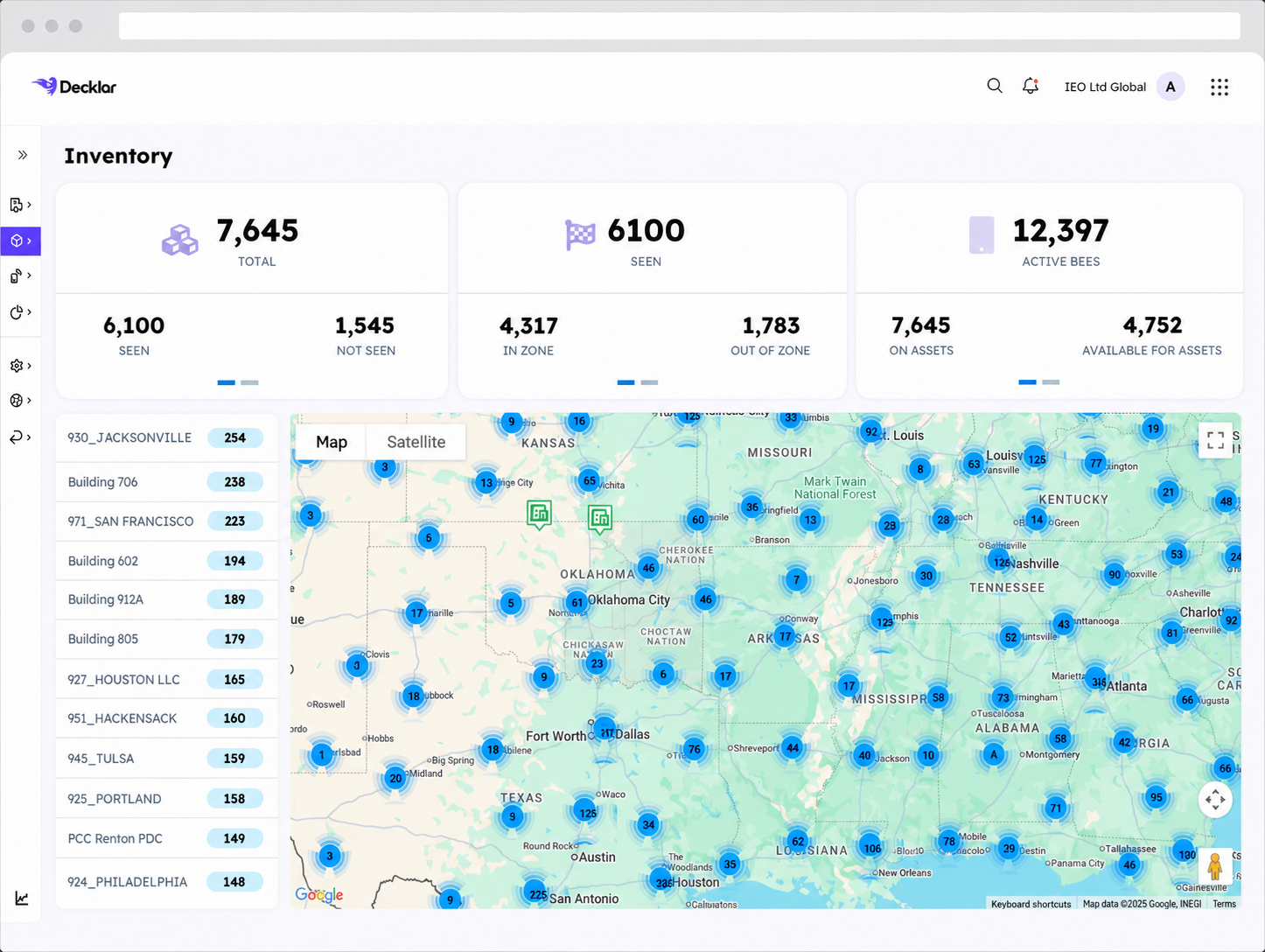
First, the platform constructs a digital twin of the assets’ current position, condition, and velocity using existing multi-source telemetry data. When data is incomplete, AI reconstructs current position from past patterns and dwell times through Probabilistic Inference (e.g. Last scan: Louisville, KY; known route: Plant Louisville → Houston DC → Austin, TX with dwell times of 24H, 27H, and 15H respectively) and Spatiotemporal Modeling (e.g. “in 48 hours it will be at Houston DC”).
Decision Intelligence Layer
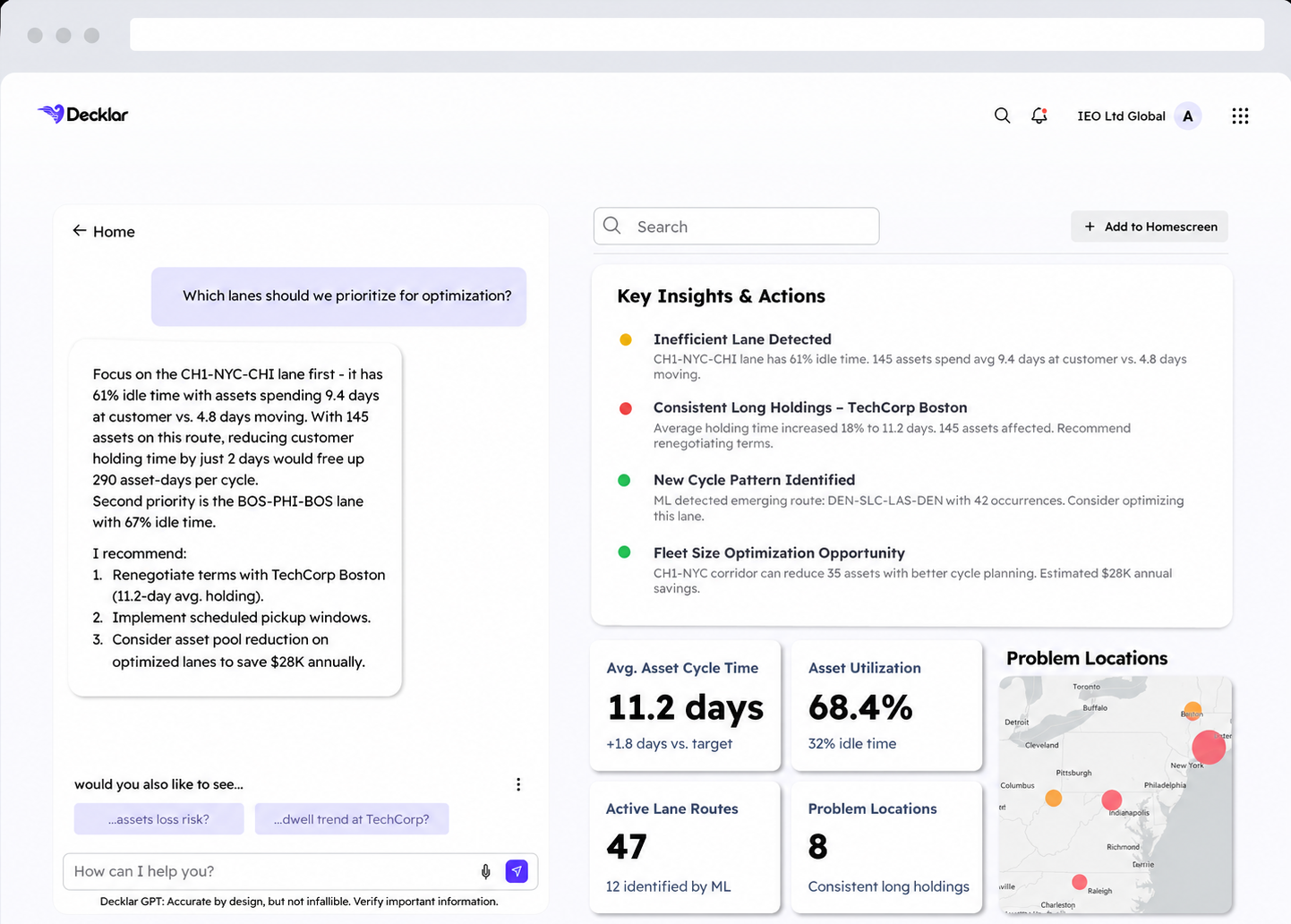
An agentic layer integrated with ERP/TMS systems that predicts when assets are ready for return, forecasts supply-demand imbalances across upcoming dispatches, and prescribes optimal repositioning, allocation, maintenance, and procurement decisions.
Autonomous Execution Layer
Automated multi-channel coordination—via email, Microsoft Teams, WhatsApp, and voice AI—that executes recovery and repositioning decisions across all stakeholders. The system builds a behavioral digital twin of each operator, learning the most effective channel, timing, and escalation path for faster, more reliable execution.
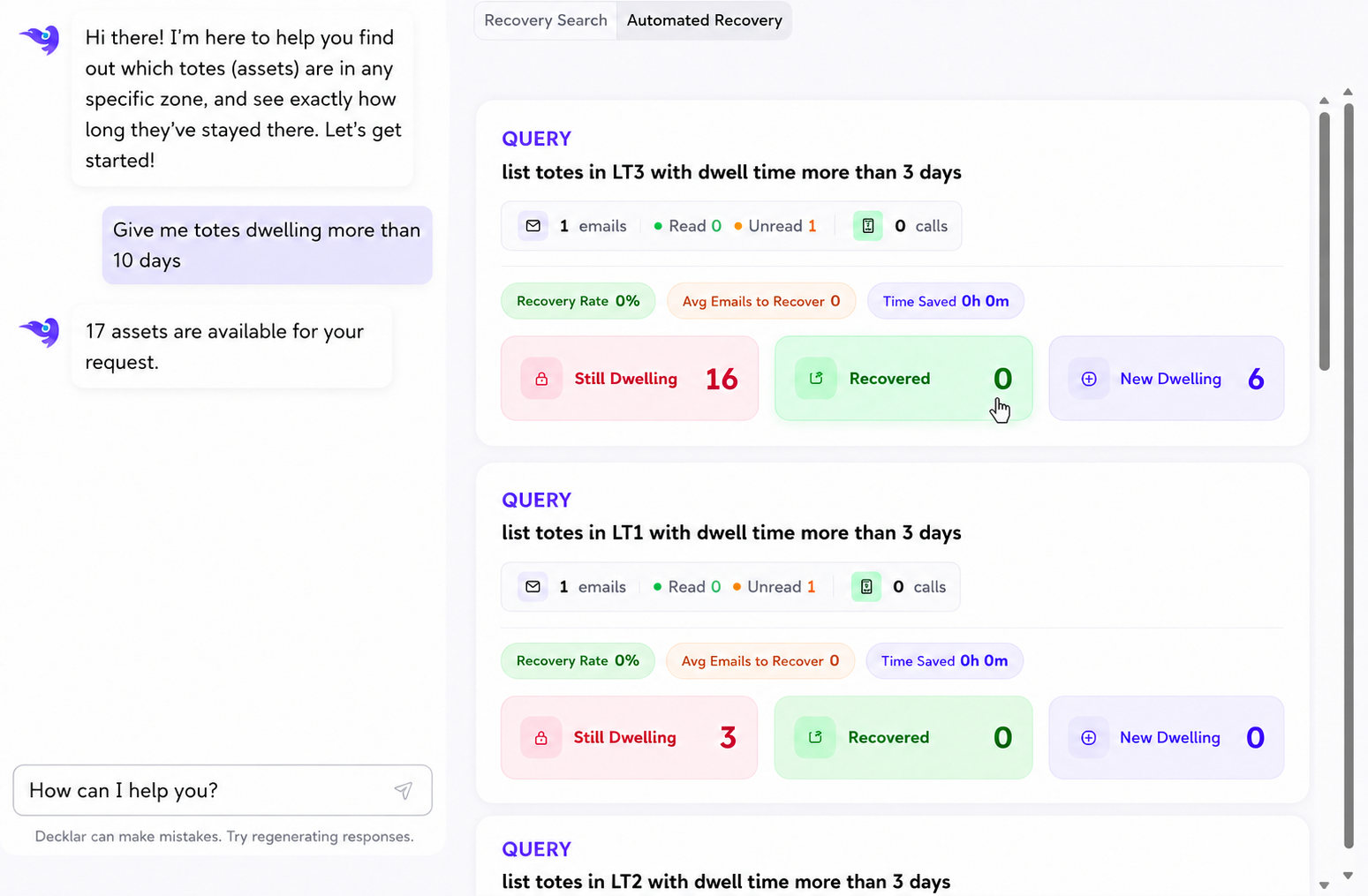
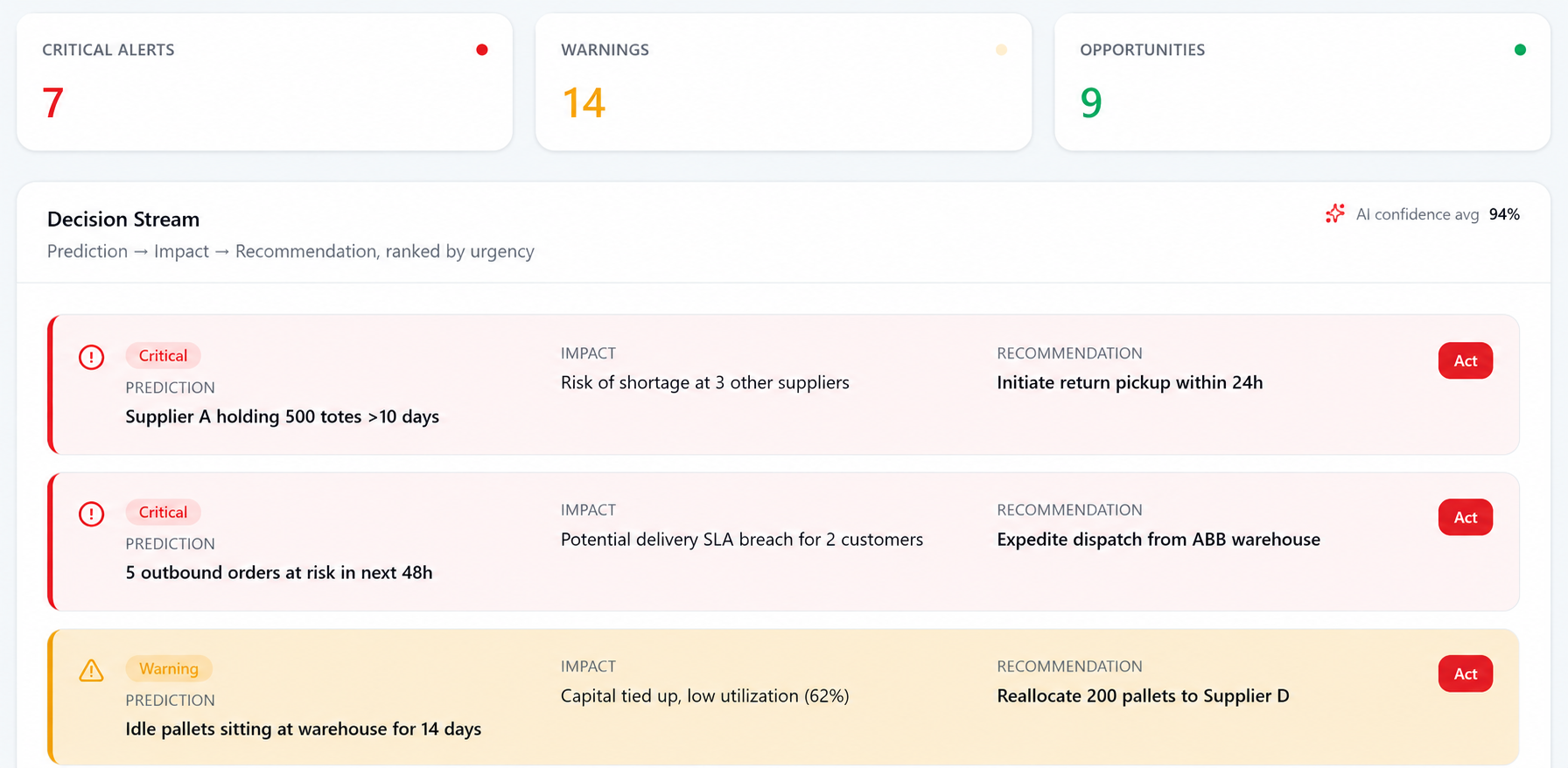
This architecture enables Global 2000 enterprises to transform the asset data they already generate into reliable, autonomous decisions—without capital investment in new tracking hardware or data infrastructure.
Deployment Phases
The deployment unfolded for the customer in three distinct phases, each building on the last:
Phase 1-Day 1 | • Real-time tote location, movement & dwell time across an initial 8 plants and hundreds of end locations • Automated flagging of dwell time violations and idle tote exceptions • Immediate reduction in temporary packaging use |
Phase 2-Day 2 | • Persona-driven dashboards: site operators received idle tote alerts; plant managers tracked packaging spend; global planners used AI-driven capacity models • Lane-level circulation benchmarking and recovery action recommendations • Capital planning intelligence: AI-justified redistribution over new asset purchases |
Phase 3-Day 3 | • Automated recovery and repositioning executed across plants, suppliers & transport partners • Multi-channel workflow automation: Email, Microsoft Teams, WhatsApp, and Voice AI • Behavioral digital twin: system learned response patterns per stakeholder to optimize channel, timing & escalation • Teams shifted from manual coordination to exception management |
Aligned to SCOR Process Domains
Decklar’s platform was designed to map directly to ASCM’s SCOR Digital Standard (SCOR DS). The three-layer architecture aligns to SCOR process domains: the Intelligent Asset State Engine provides the Orchestrate layer; the Decision Intelligence Layer handles Plan (demand-driven tote allocation) and Source (predictive procurement triggers); and the Autonomous Execution Layer drives Fulfill (autonomous repositioning directives) and Return (closed-loop recovery). Progress was measured against the SCOR Asset Management attribute—primarily Asset Turns (AM.1.3) and Cash-to-Cash Cycle Time (AM.1.1)—and the SCOR metrics hierarchy informed the KPI design, so each output maps to a recognized process category and can be benchmarked against industry standards.
Measured Results & ROI
ROI Measured at Just One Plant Over Two Weeks
The following results were captured at one of the customer’s 28 plants—850 totes tracked, with a 3-day dealer return KPI, automated dwell alerts sent twice weekly to transporters.
- Stranded Totes
Totes Freed for Shipping
Annual Turns Gained
Saved Weekly
Labor $/year Saved
Before vs. After (2-Week Cycle)
| Metric | Before Decklar | After Decklar |
|---|---|---|
| Totes stranded at dealers | 150 totes | 70 totes ▼ 53% |
| Active tote availability | 82% (700 of 850) | 92% (780 of 850) ▲ |
| Annual tote turns (pool)-Asset Turns (AM.1.3) | ~84,000 turns/year | ~93,600 turns/year ▲ |
| Weekly labor on RPC tracing | 10 hours/week (manual) | 0 hours/week ✓ Automated |
| Single-use packaging cost | $25/unit when reusables are scarce | Declining-$2,000 avoided/cycle |
| Loss & damage accountability | Unattributable-cost absorbed | Fully attributable by last location |
Estimated Annual Projection of Impact at Full Scale Across All 28 Plants
The following table summarizes the direct financial impact delivered and projected through the Decklar deployment across all plants:
| Value Driver | Potential Annual Impact | Category |
|---|---|---|
| Elimination of emergency/temporary packaging costs (100+ daily shipments @ $20–$25 each) | $912,000 per year | Cost Savings |
| Manual labor savings from automated monitoring & coordination | $436,000 per year | Cost Savings |
| Avoiding new tote purchases (10% utilization improvement = same output, fewer assets) | $250,000 avoidance | Capital Efficiency |
| Potential revenue unlocked by deploying existing tote inventory to unserved demand | $3.6 million per year | Revenue Growth |
| Total Projected Direct Annual Impact Estimation | $5.2 million per year |
Impact Across All Five SCOR Performance Attributes
While the program was scoped and measured against the SCOR Asset Management attribute, the gains cascaded measurably across all five SCOR Level-1 performance attributes—evidence that improving asset circulation strengthens the supply chain as a system rather than optimizing one metric in isolation:
| SCOR attribute | Representative SCOR metric | How the deployment moved it |
|---|---|---|
| Asset Management (primary) | Asset Turns (AM.1.3); Cash-to-Cash Cycle Time (AM.1.1) | Annual turns +11.4% (~84,000 → ~93,600); utilization 82% → 92%; stranded totes −53%; $250K new-asset capital avoided; idle capital returned to circulation faster. |
| Reliability | Perfect Order Fulfillment (RL.1.1) | Higher tote availability (92%) and fewer shortages reduced JIT stockout risk, strengthening on-time parts delivery to dealers and downstream partners. |
| Responsiveness | Cycle time (RS)—asset-recovery cycle | Recovery shifted from a 10-hour/week/person’s manual chase to autonomous, twice-weekly action, compressing the time to detect and resolve idle-asset exceptions. |
| Agility | Adaptability / flexibility (AG) | Freed inventory could be redeployed to unserved demand without new purchases—letting the network flex capacity to demand shifts (a projected $3.6M revenue opportunity). |
| Cost | Total Cost to Serve (CO.1.1) | ~$0.9M/year eliminated emergency/temporary packaging and ~$0.4M/year recovered manual-coordination labor—roughly $1.3M/year removed from cost to serve. |
Indirect and Strategic Benefits
- On-time delivery promise fulfillment to dealers and downstream distribution partners
- Improved capital allocation: AI-justified redistribution reduced unnecessary tote purchases
- Streamlined capital expenditure budgeting for future fiscal years
- Strengthened trust and reliability with downstream stakeholders through consistent asset availability
- Sustainability improvement: higher tote utilization and reduced reliance on single-use packaging advances Scope 1, 2, and 3 emissions targets
Summary
By deploying Decklar’s Reusable Asset Automation AI, the customer transformed tote operations from reactive, labor-intensive coordination into a predictive, autonomous system that manages every asset across every site and every stakeholder—without adding inventory or headcount.
The impact—spanning cost elimination, capital efficiency, and revenue growth—was achieved not by investing in new tracking infrastructure, but by building a layer of autonomous judgment on top of the data the customer already had but was unactionable. This is the innovation: turning operational telemetry into reliable, self-executing decisions at enterprise scale.
As supply chains face mounting pressure to do more with the same assets, the ability to autonomously manage reusable packaging represents a significant competitive advantage and a more sustainable operating practice—one that Decklar is uniquely positioned to deliver.