Supply Chain Visibility: How Real-Time Execution Signals Are Transforming Network Design

I have spent a significant part of my career designing supply chain networks. Building optimization models. Running stochastic simulations. Stress-testing scenarios across regions and industries. Balancing service, cost, and inventory trade-offs in environments where small assumptions often have large consequences.
The mathematics has never been the constraint.
Modern network design tools are powerful. They can optimize cost-to-serve, simulate thousands of scenarios, and identify theoretically optimal network configurations. Yet despite increasingly sophisticated models, many supply chains still struggle once designs are operationalized. Service erodes, buffers expand, exceptions multiply, and leaders are forced into reactive decision-making.
The underlying issue is not modeling capability. It is that network design decisions are still anchored to execution assumptions that no longer reflect how supply chains actually behave.
Visibility for Real-Time Execution Is Not New. Decision-Grade Signals Are.
Execution data has existed in supply chains for decades. ERP events, EDI milestones, and carrier status updates have long documented what happened and when.
What has changed is the emergence of telemetry-grade execution signals.
Telemetry is high-frequency, sensor- or system-generated execution data collected continuously across physical supply chain flows, enabling statistical modeling of variability, dwell, correlation, and recovery behavior at lane, node, and network levels.
These signals capture location, condition, dwell, handover behavior, and recovery patterns continuously as flows move through the network. They reveal not just outcomes, but behavior. Not just averages, but distributions and volatility.
This evolution materially changes the inputs available to network design. Supply chain visibility is no longer an operational overlay applied after design. It is becoming a foundational data layer that informs how networks should be designed, stress-tested, and periodically recalibrated.
Where Traditional Network Design Starts to Break Down
Classic network design relies on simplification. This is not a flaw, but a necessity.
Transit times are averaged. Service levels are assumed. Dwell is modeled at nodes, typically as a stable parameter. Variability is smoothed. Correlation across nodes and corridors is rarely captured explicitly.
These assumptions are reasonable under stable conditions. They begin to fail when volatility becomes structural.
Systemic events such as port congestion, geopolitical disruption, regulatory tightening, labor constraints, or routing shifts do not affect a single node in isolation. They change dwell behavior, handover latency, and reliability across entire corridors. Most planning models do not recalibrate these assumptions holistically or fast enough to reflect how risk accumulates across the network.
The result is a familiar pattern. Supply chain optimization converges on solutions that are mathematically sound, but operationally fragile once real-world conditions assert themselves.
What Supply Chain Visibility Changes for Network Design
The right supply chain visibility software offers telemetry-grade execution signals. The telemetry-grade execution signals change the practice of network design in several important ways.
First, they expose distributions rather than averages. Instead of designing for mean transit time, planners can design for volatility, tail risk, and service reliability. This directly influences safety stock placement, buffer sizing, and service commitments.
Second, they reveal where instability actually forms. Dwell accumulation, handover friction, and recovery time become design inputs rather than operational surprises. Nodes and corridors can be evaluated based on how they behave under stress, not how they perform under ideal assumptions.
Third, they enable continuous recalibration. Network design stops being a static annual exercise and becomes a living discipline. Design assumptions can be periodically refreshed based on how the network is actually behaving, reducing the gap between design intent and operational reality.
In practice, this leads to fewer post-go-live surprises and materially lower recovery cost.
From Supply Chain Network Design to Network Decisioning
One of the most important shifts underway is the evolution from network design as a one-time optimization exercise to network decisioning as an ongoing capability.
Telemetry makes this possible.
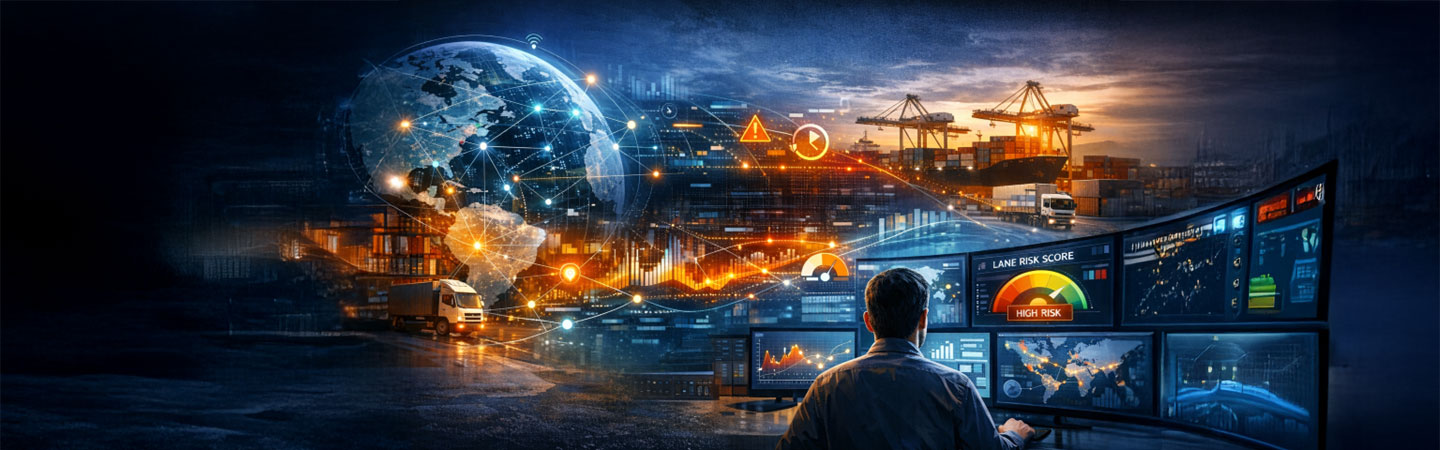
When execution signals are captured consistently and normalized, they can be translated into actionable decision inputs. A practical example of this evolution is lane-level risk scoring.
Rather than treating lanes as fixed combinations of cost and lead time, a lane risk score reflects current exposure. It incorporates telemetry-derived indicators such as transit-time volatility, dwell accumulation, handover latency, exception frequency, condition excursions, and recovery behavior, combined with contextual signals.
For network designers and planners, this enables earlier and more targeted decisions:
Identifying lanes that are becoming structurally unstable
Repositioning buffers before service deteriorates
Adjusting routing and carrier strategies while options still exist
Re-evaluating cost-to-serve as volatility increases
At Decklar, this thinking informs our Lane Risk Score capability. It is not intended to replace network design tools, but to feed them with execution reality and guide intervention between formal planning cycles.
What This Means for Senior Leaders
For leaders accountable for supply chain performance, the implications are concrete.
Networks designed purely on historical averages will continue to drift under volatility. Networks designed and continuously informed by telemetry-grade execution signals adapt earlier and fail less expensively.
For planning and network design leaders, this improves model fidelity and narrows the planning-execution gap that emerges after go-live.
For resilience and compliance leaders, it provides early warning, defensibility, and evidence of what was known and when decisions were made.
For technology leaders, it reframes visibility as a strategic data asset rather than a reporting layer.
Where Human Judgment Still Matters
Even the most sophisticated data does not replace judgment.
Network design remains a strategic discipline. Trade-offs between cost, service, risk, and compliance require experience and context. What supply chain visibility changes is not the need for human decision-making, but the timing of it. Leaders are no longer forced to decide after outcomes are locked in.
They can decide while there is still room to act.
The Takeaway
Network design is no longer about optimizing a static representation of the supply chain. It is about designing for how the network actually behaves under real conditions.
Real-time supply chain visibility & telemetry-grade execution signals make that behavior visible. Decision Intelligence determines whether those signals shape decisions in time.
Organizations that embrace this shift will design networks that absorb disruption rather than amplify it. Those that do not will continue to optimize elegant models of a network that exists only on paper.

Nitesh Mandal, Regional Vice President, EMEA, Decklar
Nitesh Mandal is the Vice President of Sales for EMEA & India at Decklar, with over 15 years of experience driving supply-chain efficiency and digital transformation for global enterprises. In this role, he leads sales and account management, helping Global 2000 organizations implement Decision AI across complex supply chains. Prior to joining Decklar, Nitesh held senior global leadership roles at Maersk, most recently as Head of Growth, Strategy & Solution Design, where he managed multi-million-dollar P&L portfolios and led warehousing, logistics, and supply-chain optimization initiatives. He holds a Master’s degree in Logistics and Supply Chain Management from Lancaster University, UK, along with CLTD and CSCP certifications from APICS.