
Hello everyone,
As we begin 2026, I’m pleased to report that Decklar is entering the year with strong momentum exiting 2025: 48% YoY revenue growth, adjusted EBITDA positive for 3 quarters, cash-neutral from operations, and strong Global 2000 enterprise traction with average customer contract commitments of approximately three years. These metrics reflect one thing clearly—Decklar is becoming the core decision layer of modern supply chains.
In the first half of 2025, we shared a clear belief: visibility alone is no longer enough for modern supply chains. This was evident from my meetings with more than 50 supply chain leaders across 4 continents in 12 months. H2 was thus a clear behavior shift: enterprises are no longer asking for “better visibility.” They’re asking for systems that prevent supply chain crises and automatically drive action across teams. We thus built the autonomous decision layer that runs product flow. You can read more in my blog here.
The second half of the year marked the moment that belief turned into execution.
On September 10, 2025, Roambee officially rebranded to Decklar (a name inspired by “Decision Clarity”). This milestone represented far more than a name change. It marked our evolution into a Real-Time Decision AI company, built to help global supply chains move from observing what happened to deciding what should happen next in milliseconds.
September 10, 2025: The Launch of Decklar
The rebrand to Decklar was the culmination of a decade of work on visibility, data engineering, and AI. It better reflected our AI-native platform designed for enterprise-scale supply chain operations (“a decision co-pilot”).
What makes the Decklar Decision AI platform fundamentally hard to replicate is that we didn’t start with AI—we started with the visibility data foundation required for AI to reliably operate chains. Over a decade, we’ve built a proprietary supply chain knowledge graph mapping more than 50% of the world’s commercial trade lanes: 10M+ nodes across 15K+ lanes, enriched by 12M+ live shipment signals daily and 1B+ historical logistics events. This is a “B2B Google Earth” foundation that compounds over time—and it is the reason Global 2000 enterprise trust Decklar’s platform as the preferred Decisioning Layer. With every new shipment tracked, our Decision AI becomes 1-3% smarter every week.
Decklar is built for Global 2000 enterprises that are running complex, high-stakes product flows in verticals such as Pharma, Food, CPG, Electronics, Chemicals, & Automotive—where delays, excursions, theft, or inventory errors directly impact revenue, compliance, and brand promise.
In this short video, I share why this transition matters and what it means for the future of supply chain operations:
Read our official rebrand announcement which outlines this shift in more detail.
From Visibility to Decision AI in Production
H2 was not about strategy. It was about infusing our Decision AI platform effectively into our customers’ operations.
We deployed the production version of the Decklar AI platform, strengthening the foundation required to support autonomous, explainable Decision AI at scale. This platform brings together real-time visibility, operational context, and AI-driven reasoning to enable faster, more confident action across complex supply chains.
This resulted in an average of 2.3 of our 8 Decision AI solutions adopted by an enterprise customer and embedded into their supply chain workflows.
As part of this platform evolution, we also launched RADAR, the first fully autonomous logistics control tower. It expanded our ability to autonomously orchestrate actions to mitigate risk of disruptions & protect critical revenue in transit, by continuously monitoring shipment health and leveraging early risk signals.
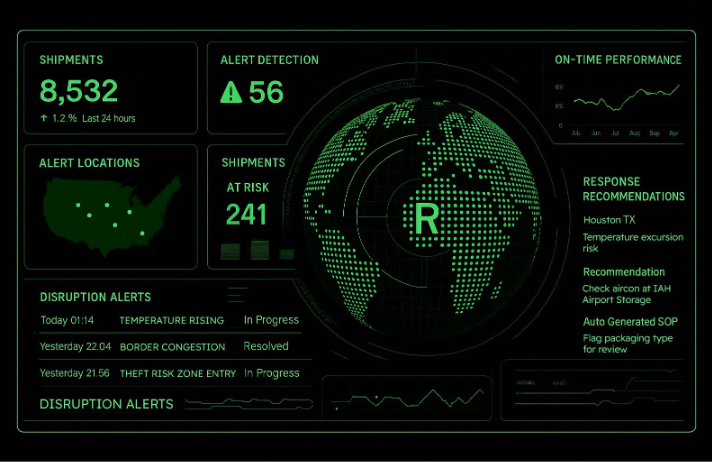
We shared more detail about RADAR in a recent press coverage here.
AI Embedded Where Decisions Actually Happen
In H2, AI moved closer to execution.
Decision logic is now embedded directly within operational workflows to support:
- Automated detection of exceptions
- Intelligent escalation to the right stakeholder
- Faster resolution of issues that impact compliance and service levels
We also introduced new interaction models that make AI more accessible and actionable, including natural-language dashboards and automated outreach to accelerate response when intervention is required.
The focus throughout was simple: reduce friction between insight and action.
The Rise of Asset-Level Intelligence
Another clear shift emerged over the course of 2025.
Historically, supply chain intelligence focused on shipments and containers. Increasingly, enterprises are extending intelligence to assets such as racks, bins, tooling, displays, compressors, and returnable equipment.
This shift reflects a broader change in how operations are managed. Assets are no longer static. They are continuously sensed, scored, and acted upon. This expansion of intelligence beyond shipments is reshaping how organizations think about control, utilization, and resilience.
What H2 2025 Reinforced
During the second half of the year, several truths became clear:
- Data without decisions creates friction, not advantage
- AI must be explainable, embedded, and operational for adoption
- The future belongs to systems of action, not systems of record
These insights shaped everything we delivered in H2.
The result: across multiple Global 2000 deployments, Decision AI has now moved from pilot to operational scale—expanding into workflows like automating product release, security risk anticipation, demurrage prevention, boosting asset performance, and real-time replenishment decisioning.
Looking Ahead to 2026
In 2026, we believe the next phase of supply chain software will look very different from the last decade.
Enterprises stop buying Visibility or System of Records as a standalone category. They will buy automation that pays for itself—and they will measure platforms by how fast they prevent disruption, not how well they report it.
For Decklar, this means expanding from visibility + exception detection into autonomous resolution loops, scaling Decision AI across all three strategic areas—operational automation, risk & resilience, and performance & forecasting—and deepening our ability to “start with one supply chain workflow and expand into everything in weeks.”
My commitment is that Decklar will set the operating standard for real-time supply chain decisioning. We will earn that position by shipping enterprise-grade AI that is explainable, embedded, and measurable—and by driving outcomes, not software, as the unit of value.
Warm Regards,
Sanjay Sharma,
Chairman & CEO
Decklar

Sanjay Sharma, Chairman & CEO, Decklar
Sanjay Sharma is a strategic thought leader with an impressive 17+ years of entrepreneurial experience building technology startups from the ground up. As CEO of Decklar, he is responsible for leading the company’s vision, driving its worldwide business growth, and increasing Decklar's value. Sanjay has successfully co-founded and led two successful Silicon Valley technology startups - KeyTone Technologies, which was acquired by Global Asset Tracking Ltd and Plexus Technologies, which became an ICICI Ventures portfolio company. He has also been a part of the engineering teams at EMC, Schlumberger, and NASA. Sanjay has a Bachelor's Degree in Electronics Engineering from the University of Bombay, and a Master of Science in Electrical Engineering from South Dakota State University.